
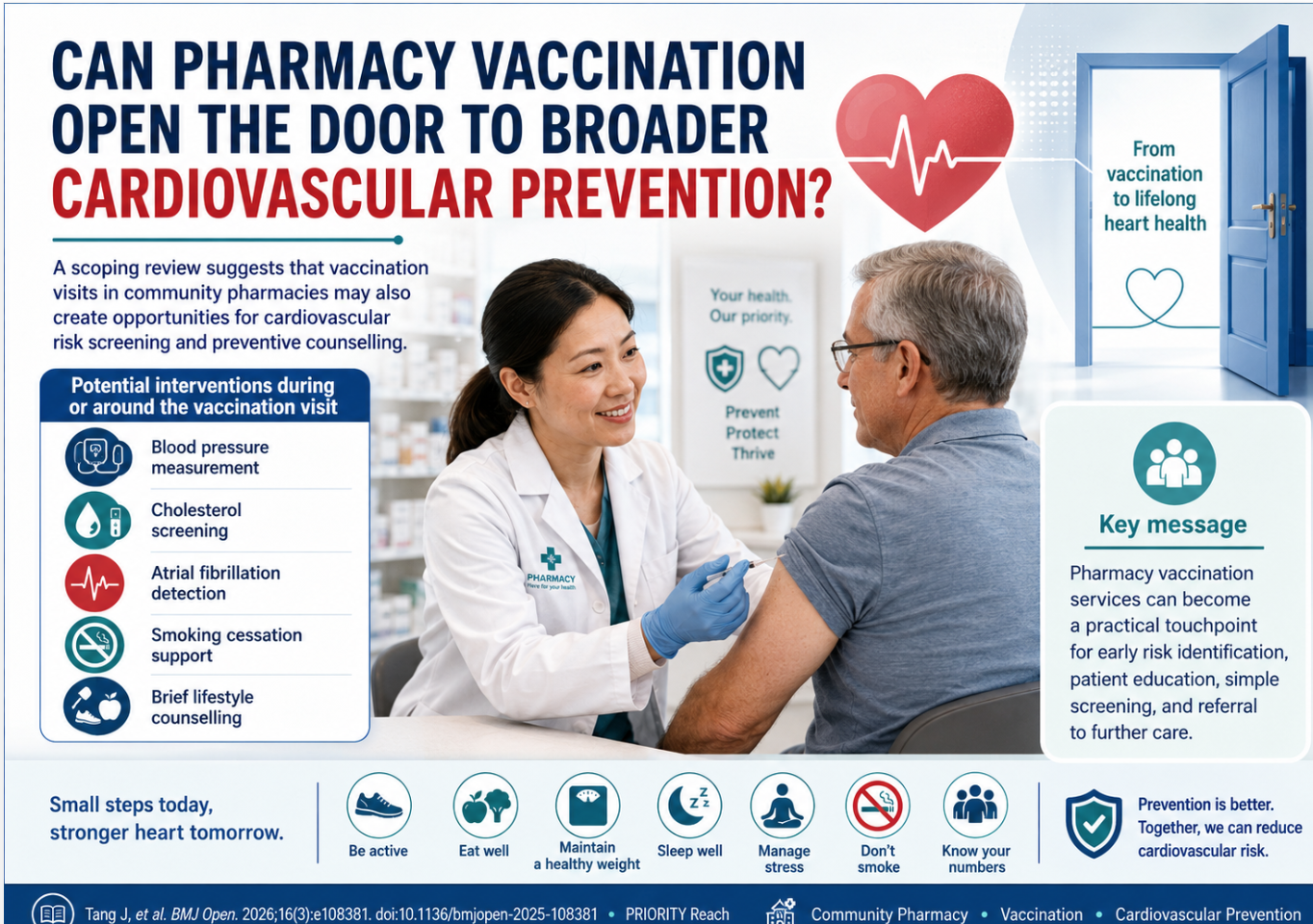
Community pharmacies are increasingly no longer viewed solely as places where medicines are dispensed. Vaccination services delivered by pharmacists have demonstrated that pharmacies can effectively contribute to public health, reach patients who engage less frequently with other parts of the healthcare system, and support the prevention of chronic diseases. This raises an important question: can a patient’s vaccination visit to a community pharmacy also be used as an opportunity to assess cardiovascular risk? In our latest publication, “Integrating cardiovascular healthcare screening into a community pharmacy vaccination service: a scoping review to identify opportunities for patient engagement and service expansion,” we examined the potential for combining pharmacy-based vaccination services with additional preventive interventions targeting cardiovascular disease. The publication was developed through a scientific collaboration associated with the PRIORITY Reach project, involving Aston University and partners from UK community pharmacy practice and the wider healthcare system. The aim of the study was to identify services that pharmacists could provide during a vaccination appointment or in direct connection with such a visit. The authors reviewed studies covering interventions including blood pressure measurement, cholesterol screening, atrial fibrillation detection, smoking cessation support, and brief lifestyle interventions. The review included UK empirical studies published between 2013 and 2024. Of the 8,322 records identified, 53 studies were included in the final analysis. A vaccination appointment creates a natural point of contact with a person who may have no apparent symptoms of disease but may still have undiagnosed risk factors, such as hypertension, lipid disorders, an irregular heart rhythm, tobacco use, or an unhealthy lifestyle. The pharmacist can use this opportunity not only to administer a vaccine, but also to initiate a brief preventive conversation, perform a simple measurement, or refer the patient for further assessment. Across the studies included in the review, the availability of a separate consultation room was an important factor supporting service delivery. Appropriate training, clearly defined clinical procedures, and access to digital tools and screening devices—for example, equipment capable of detecting atrial fibrillation—were also important.
Some patients also raised concerns about privacy, particularly where the pharmacy premises did not provide adequate conditions for confidential consultations. Importantly, only five studies described the successful integration of lifestyle interventions into community pharmacy services. Long-term clinical outcomes were rarely reported. This means that although the available evidence supports the feasibility and high acceptability of the proposed model, controlled studies are still needed to evaluate its impact on actual patient health outcomes and healthcare system costs. Cardiovascular diseases can develop for many years without producing clear symptoms. Many patients discover that they have hypertension, an abnormal heart rhythm, or elevated cholesterol only by chance.
People attending a pharmacy for vaccination represent a population that can be reached in a simple and convenient way, without requiring an additional appointment at another healthcare facility. Combining vaccination with a brief health-risk assessment could therefore increase the value of every patient visit to a community pharmacy. Community pharmacies have genuine potential to combine vaccination services with cardiovascular prevention. This is also an important message for Poland. The development of pharmacy-based vaccination services should not be treated as a closed, isolated project. It could provide the foundation for a broader preventive-care model in which pharmacists identify risk, perform basic measurements, educate patients, and help them access the appropriate healthcare professional.
Pharmacists do more than vaccinate. They may also identify a problem before the patient becomes aware of it.